I should start this post by thanking everyone who has sent me mail. I especially want to thank Laura who sent me an awesome birthday package.
Mail is an interesting phenomenon for me, especially here. I never thought that I would be a big fan of getting mail. Here, though, its different.
Since I can no longer get regular, instant gratification from email, I look forward to the bi-weekly post deliveries in Kouka. At least they are supposed to be bi-weekly. Sometimes they are, sometimes they aren't. The exact days for delivery are always a surprise too.
As near as I can tell, it takes a letter or package about 8-10 days to get from Indiana to Lome. Snowstorms really screw up this estimate. From Lome, it takes 4-5 days for packages to get up here. This is because of the road conditions. I think it takes maybe two days for stuff to get up to Kante, which is almost directly east of me, but is on the Route National.
I have an audience raptly reading this as I type it.
I've heard stories from other Volunteers about care packages, in boxes, that have arrived pre-opened and missing items. I've heard about packages that have never made it. I don't think that this has happened to me yet. Other packages get here via the Caribbean or after a European tour. Its all part of the excitement of getting mail.
I get two kinds of mail. The first kind is called EMS. I can't remember what the acronym stands for, but it is a free, internal Togolese (?) mail service that the Peace Corps uses. That's how we get, for example, medicines from Lome, or PC-Togo fliers, pay statements, official information, etc. I just used it, for example, to send one of my friends a Sports Illustrated that I was finished with.
The second type of mail I get is stuff from the States. I have to pay 1 mille CFA for each package/large envelope that I get, but its totally worth it.
Mail gives me a tangible connection to those of you back in the States. The stuff in the mail more so. Getting it is usually the highlight of my week.
Since I am talking about mail, I will unabashedly promote sending your favorite PCV all kinds of stuff. He likes the following items-- junk food- both sweet and salty- (i would kill for Lays kettle cooked chips right now), also other non-perishable food items. Magazines, like Sports Illustrated, the Economist, the New Yorker, Newsweek etc, anything that gives me an intelligent discussion about the wider world. Books. Sending me movies, TV shows, and music on thumb drives or SD cards is guaranteed to get you a personalized response if you want said devices back. Pictures. You can also write me letters too. If you ask me interesting questions, I will respond. Its part of my job.
Whatever you send me will make someone happy in some way. Magazines circulate among Volunteers. Togolese LOVE them too; its hard explaining all the advertisements sometimes though. Food gets shared. My cluster is especially good about this. Like when Laura sent me real Kraft macaroni and cheese, me and my friend Karen made some with a package of salmon she'd gotten from home. It was delicious.
Tuesday, March 1, 2011

Monday, February 14, 2011
Jim Morrison said it best
"this is the strangest life I have ever known"
that's kind of the motto of my sojourn here in Togo. The exotic is normalized, mostly. Accessing Facebook is a pain in the ass. What used to be normal, like cell phone reception, hot showers, and facebook, is exotic.
I've found stuff that I thought I would find here and other stuff I never believed I would find here.
I've met wonderful people, amazing people, and amazing intelligent people. And I've yelled at assholes and tried to tackle a would-be mugger.
I realized that the only limit to what people can do is the limits that people put on themselves.
I also realized carrying a moto through a river is perfectly acceptable.
I ate goat testicles.
I have yet to meet someone who is fundamentally different than me
One of my best friends in village is a devout catholic. Another one of my best friends in village is a devout muslim. Another practices traditional religion. They live next to each other and get along just fine. People need to take notes.
I finally found an animal that Togolese, or at least the Konkumba, dont eat. Crocodile. I think that this is because crocodiles are reputed to eat people.
I never thought that I would love "tofu."
The thought of planting trees or designing a chimney for a thatched roof is really exciting.
At least once a week I have the following realization "holy crap, I am in Africa"
its the strangest life Ive ever known
that's kind of the motto of my sojourn here in Togo. The exotic is normalized, mostly. Accessing Facebook is a pain in the ass. What used to be normal, like cell phone reception, hot showers, and facebook, is exotic.
I've found stuff that I thought I would find here and other stuff I never believed I would find here.
I've met wonderful people, amazing people, and amazing intelligent people. And I've yelled at assholes and tried to tackle a would-be mugger.
I realized that the only limit to what people can do is the limits that people put on themselves.
I also realized carrying a moto through a river is perfectly acceptable.
I ate goat testicles.
I have yet to meet someone who is fundamentally different than me
One of my best friends in village is a devout catholic. Another one of my best friends in village is a devout muslim. Another practices traditional religion. They live next to each other and get along just fine. People need to take notes.
I finally found an animal that Togolese, or at least the Konkumba, dont eat. Crocodile. I think that this is because crocodiles are reputed to eat people.
I never thought that I would love "tofu."
The thought of planting trees or designing a chimney for a thatched roof is really exciting.
At least once a week I have the following realization "holy crap, I am in Africa"
its the strangest life Ive ever known
Dust dust everywhere makes me need a drink
I just got done with a week of In-Service Training at the Peace Corps' center in central Togo. It was fun. I learned about cool stuff like how to make a salt block and how to make charcoal powder into usable briquettes.
Anyway, getting there necessitated a lot of travel. Traveling in Togo, the act of getting from point A to point B, is an interesting experience. The main mode of long distance travel is the bush taxi. this is a toyota, or mazda, van that has been extensively modified with a cargo rack, beefed up suspension, and extra seats. Many of them have also been patched back together. Depending on the number of babies, the bush taxi carries about 21 people when fully loaded. Seating requires negotiation and a willingness to swap a lot of sweat.
The plus side is that Togolese take traveling seriously; most of them dress in their best clothes. It makes me feel bad since I am more interested in which Tshirt that I only want to wear once.
In addition to being stuffed with people, bush taxis carry a lot of cargo. It is not unusual to see a bush taxi whose height is doubled, or more, by the amount of cargo stacked on top. I saw one today with a moto strapped upright over the driver's seat.
The Route National is the main road that runs north/south through Togo. The remoteness of one's village is directly proportional to distance to the Route.
At its best, the Route is roughly equivalent to a state highway back in the States. At its worst, the Route, well, doesnt have any asphalt where it washed out. Most of the time it is a pothole infested obstacle course.
Massive lorries use this road, their size determined by how much stuff can be crammed on them, as opposed to a weight limit. The Route through the passes in Togo's diminutive mountains is littered with the hulks of crashed, broken down, and turned over trucks. Alisha has trouble getting back to her village from the regional capitol because the Route is often blocked by wrecks in this certain pass.
Today, for example, i saw this one lorry being driven up a mountain. It had obviously just wrecked. The cab was crushed, the roof caved in, and the pieces tossed in the trailer. But the engine still worked, so some guys were driving it off.
Bush taxi hulks are somewhat less common.
Driving in Togo requires a lot of skill, luck, and optimism. For example, "my brakes are burning going down this mountain, but Im sure they wont fail." Lanes are more of an idea than an actuality. Drivers treat potholes as obstacles to be avoided, even in the face of an oncoming overloaded lorry. I dont blame them. Some of the potholes are big enough to gut the underside of any vehicle. It is kind of fun careening through towns with the horn blaring and watching people, goats, dogs, and the odd chicken diving out of the way.
The Route is also a footpath. Crowds of school kids use it to walk home. There are no shoulders. Use your imagination.
Anyway, getting there necessitated a lot of travel. Traveling in Togo, the act of getting from point A to point B, is an interesting experience. The main mode of long distance travel is the bush taxi. this is a toyota, or mazda, van that has been extensively modified with a cargo rack, beefed up suspension, and extra seats. Many of them have also been patched back together. Depending on the number of babies, the bush taxi carries about 21 people when fully loaded. Seating requires negotiation and a willingness to swap a lot of sweat.
The plus side is that Togolese take traveling seriously; most of them dress in their best clothes. It makes me feel bad since I am more interested in which Tshirt that I only want to wear once.
In addition to being stuffed with people, bush taxis carry a lot of cargo. It is not unusual to see a bush taxi whose height is doubled, or more, by the amount of cargo stacked on top. I saw one today with a moto strapped upright over the driver's seat.
The Route National is the main road that runs north/south through Togo. The remoteness of one's village is directly proportional to distance to the Route.
At its best, the Route is roughly equivalent to a state highway back in the States. At its worst, the Route, well, doesnt have any asphalt where it washed out. Most of the time it is a pothole infested obstacle course.
Massive lorries use this road, their size determined by how much stuff can be crammed on them, as opposed to a weight limit. The Route through the passes in Togo's diminutive mountains is littered with the hulks of crashed, broken down, and turned over trucks. Alisha has trouble getting back to her village from the regional capitol because the Route is often blocked by wrecks in this certain pass.
Today, for example, i saw this one lorry being driven up a mountain. It had obviously just wrecked. The cab was crushed, the roof caved in, and the pieces tossed in the trailer. But the engine still worked, so some guys were driving it off.
Bush taxi hulks are somewhat less common.
Driving in Togo requires a lot of skill, luck, and optimism. For example, "my brakes are burning going down this mountain, but Im sure they wont fail." Lanes are more of an idea than an actuality. Drivers treat potholes as obstacles to be avoided, even in the face of an oncoming overloaded lorry. I dont blame them. Some of the potholes are big enough to gut the underside of any vehicle. It is kind of fun careening through towns with the horn blaring and watching people, goats, dogs, and the odd chicken diving out of the way.
The Route is also a footpath. Crowds of school kids use it to walk home. There are no shoulders. Use your imagination.
Tuesday, February 8, 2011
Lets see if this works . . .

entry way into the adjoining compound

funeral dance

this was during new years. i feel like the village photographer when i carry my camera around

Kodjo's father in law is a fetisher. this is him and his shrine

three of kodjo's kids. they are all really cute.

funeral dance

cute girl
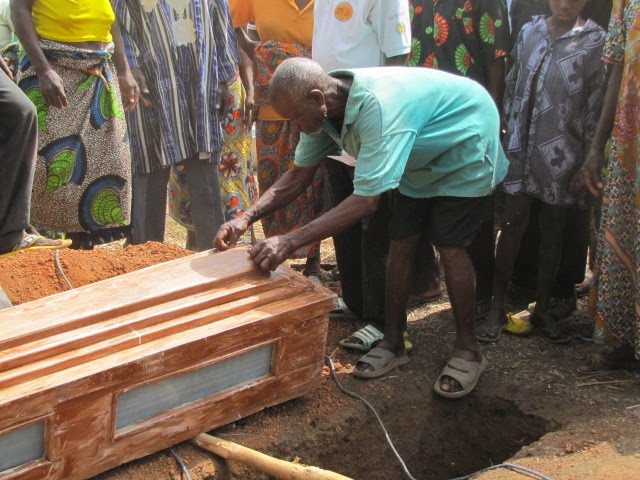
internment

Gbatope, where I did my training

me helping dig a grave . . .
New Developments
I really hope I can upload all of this stuff this time because I am tired of typing all of this stuff out on a french keyboard in an email. In the past month I: turned 29, got a new cat, finally arranged my house/finished getting my furniture (mostly) built, discovered vraiment gray hairs, and just showed my laptop to Kodjo's second wife. She has never seen one before. For those of you who are wondering about my "togolese wife," no I am not 'officially' married. I am seeing a fellow PCV; she describes herself as married (to me) to lessen unwanted attention in village. Her husband comes to visit her every couple of months, depending.
A Day in the Life . . .
A couple of people have asked me to talk about a "typical" day as a PCV here. I can"t think of one. Sorry.
I usually, however, do the following things on any given day.
I wake up between 630 and 730, depending on the noise level in my courtyard. I hang around outside for a little while trying to wake up, eating peanut butter (togolese) and bread (togolese but french-inspired) for breakfast, and greeting people who come to saluate me. Sometimes this involves talking to people who want to do projects, sometimes it involves talking about how it was hot last night and so no one slept well.
Then I get dressed and read, or go to town, or go find out who is brewing tchakba that day.
Then I drink tchakba and hang out with people.
Then, late morning, early afternoon, I repo/go hide in my house for awhile.
At 2 pm I take my doxy. my malaria medication.
Then I go over to Kodjo's house, or go drink tchakba, or read, or go learn french, etc.
Late afternoon/evening, I receive more people who come to saluate me.
Then I take a bucket shower.
Then I eat supper. Usually. Then I read/watch tv shows on my computer/ sit outside and look at the stars/ sit outside and talk to people/ help kids with their english homework.
Then I sleep.
Some days, I spent all day in Kouka. Some days I spend 20 minutes out of every 2 hours in my latrine. Some days I spend half the day or more at village events. It all depends.
I usually, however, do the following things on any given day.
I wake up between 630 and 730, depending on the noise level in my courtyard. I hang around outside for a little while trying to wake up, eating peanut butter (togolese) and bread (togolese but french-inspired) for breakfast, and greeting people who come to saluate me. Sometimes this involves talking to people who want to do projects, sometimes it involves talking about how it was hot last night and so no one slept well.
Then I get dressed and read, or go to town, or go find out who is brewing tchakba that day.
Then I drink tchakba and hang out with people.
Then, late morning, early afternoon, I repo/go hide in my house for awhile.
At 2 pm I take my doxy. my malaria medication.
Then I go over to Kodjo's house, or go drink tchakba, or read, or go learn french, etc.
Late afternoon/evening, I receive more people who come to saluate me.
Then I take a bucket shower.
Then I eat supper. Usually. Then I read/watch tv shows on my computer/ sit outside and look at the stars/ sit outside and talk to people/ help kids with their english homework.
Then I sleep.
Some days, I spent all day in Kouka. Some days I spend 20 minutes out of every 2 hours in my latrine. Some days I spend half the day or more at village events. It all depends.
Funerals are going to be the death of me
Certain of the events in this post fall under the category of "cultural integration"
I preface this post by saying that the New Year's fete here in Togo makes New Year's Eve in the States look tame and lame. I thought one bottle of gin was going to be plenty for Jan. 1st and 2nd. I needed 3.
Anyway, the morning of January 2nd, the sister of the "old man" of my compound died. My family's, and quarter's, fete was somewhat dampened as we prepared for the funeral the next day. Or so I thought. We definitely dug the grave on the 2nd. I helped. It was hard. Throughout the day I noticed people riding into my compound on bikes with 20L jugs on the back. I didn't figure out until the next day that these were full of sodobe. The room across from my house was dedicated to the distributing of sodobe. This point is important.
On the 3rd the dancing commenced. Traditional konkumba dancing. It included 2 big drums. The actual internment happened about noon. The coffin was carried out, paraded around the dance ground, and, after the woman's grieving daughter? was talked out of the grave, positioned over the opening. There some ceremonies were performed. One of them included some complicated string thing that looked kind of like a cat's cradle that was wrapped around the head of the coffin. This is purely conjecture on my part, but it looked like it had something to do with preventing something from escaping. I dont know. Anyway, the coffin was then lowered in the grave and was, along with the objects used to prepare the woman for burial, buried.
More dancing. Into the night. All throughout this guys were wandering around with bottles of sodobe and shot glasses. This was on a Tuesday.
I think there was more dancing on Wednesday, especially in the night. The women had a seperate dance a couple of times. Thursday was the day when the "strangers" came to saluate the family. Many of them came to saluate/see/frighten their kids with me. I went to Kodjo's house eventually to escape.
Friday was the last day of the funeral. They had a traditional dance throughout the day. That night, a generator and speakers were brought in and the area outside my compound was transformed into a massive dance party that lasted until 6am Saturday.
I would walk out of my door at about 7 am, and immediately be offered a shot, or several, of sodabe. Kodjo explained to me that it was custom, and a sign of respect, to offer the family of the deceased several liters of sodabe for the funeral. I bought them 5. I think it lasted half a day. I asked my host dad how much sodabe was drunk during the whole week, and he said 50-60L. Between drums, sodabe, and strangers, it was a tiring week.
Kodjo's uncle died last week. I only went to the funeral for about a day. That was enough. I was asked, however, what funerals in the States were like. I found myself trying to explain that they were somber, sober affairs. Funerals here, while there is definitely grieving, are fetes. As Kodjo explained about his uncle's funeral, because he was closely related to the man, he danced a lot in his memory. He celebrated his uncle's life. Drinking aside, this seems, to be, to be a happier perspective on funerals.
I preface this post by saying that the New Year's fete here in Togo makes New Year's Eve in the States look tame and lame. I thought one bottle of gin was going to be plenty for Jan. 1st and 2nd. I needed 3.
Anyway, the morning of January 2nd, the sister of the "old man" of my compound died. My family's, and quarter's, fete was somewhat dampened as we prepared for the funeral the next day. Or so I thought. We definitely dug the grave on the 2nd. I helped. It was hard. Throughout the day I noticed people riding into my compound on bikes with 20L jugs on the back. I didn't figure out until the next day that these were full of sodobe. The room across from my house was dedicated to the distributing of sodobe. This point is important.
On the 3rd the dancing commenced. Traditional konkumba dancing. It included 2 big drums. The actual internment happened about noon. The coffin was carried out, paraded around the dance ground, and, after the woman's grieving daughter? was talked out of the grave, positioned over the opening. There some ceremonies were performed. One of them included some complicated string thing that looked kind of like a cat's cradle that was wrapped around the head of the coffin. This is purely conjecture on my part, but it looked like it had something to do with preventing something from escaping. I dont know. Anyway, the coffin was then lowered in the grave and was, along with the objects used to prepare the woman for burial, buried.
More dancing. Into the night. All throughout this guys were wandering around with bottles of sodobe and shot glasses. This was on a Tuesday.
I think there was more dancing on Wednesday, especially in the night. The women had a seperate dance a couple of times. Thursday was the day when the "strangers" came to saluate the family. Many of them came to saluate/see/frighten their kids with me. I went to Kodjo's house eventually to escape.
Friday was the last day of the funeral. They had a traditional dance throughout the day. That night, a generator and speakers were brought in and the area outside my compound was transformed into a massive dance party that lasted until 6am Saturday.
I would walk out of my door at about 7 am, and immediately be offered a shot, or several, of sodabe. Kodjo explained to me that it was custom, and a sign of respect, to offer the family of the deceased several liters of sodabe for the funeral. I bought them 5. I think it lasted half a day. I asked my host dad how much sodabe was drunk during the whole week, and he said 50-60L. Between drums, sodabe, and strangers, it was a tiring week.
Kodjo's uncle died last week. I only went to the funeral for about a day. That was enough. I was asked, however, what funerals in the States were like. I found myself trying to explain that they were somber, sober affairs. Funerals here, while there is definitely grieving, are fetes. As Kodjo explained about his uncle's funeral, because he was closely related to the man, he danced a lot in his memory. He celebrated his uncle's life. Drinking aside, this seems, to be, to be a happier perspective on funerals.
Subscribe to:
Posts (Atom)